Why Smaller AI Agents Cost Less (but work better)
Jul 27, 2026 · 6 min read
Anthropic just deleted 80% of Claude Code’s instruction manual.
Out of curiosity, I counted the lines of code in my AI Inner Circle Command Center instructions.
475
So is this good, or bad?
I don’t know. But here is what I do know…
You pay a bill on every AI session you run. It never shows up as its own line item. It’s a hidden tax, and it is a bigger share of what these tools cost you than most people realize.
Here’s what changed
Think about hiring someone new.
For years, we handed them a thick employee handbook with every rule spelled out. The book had to be thick, because they were new and would guess wrong without it.
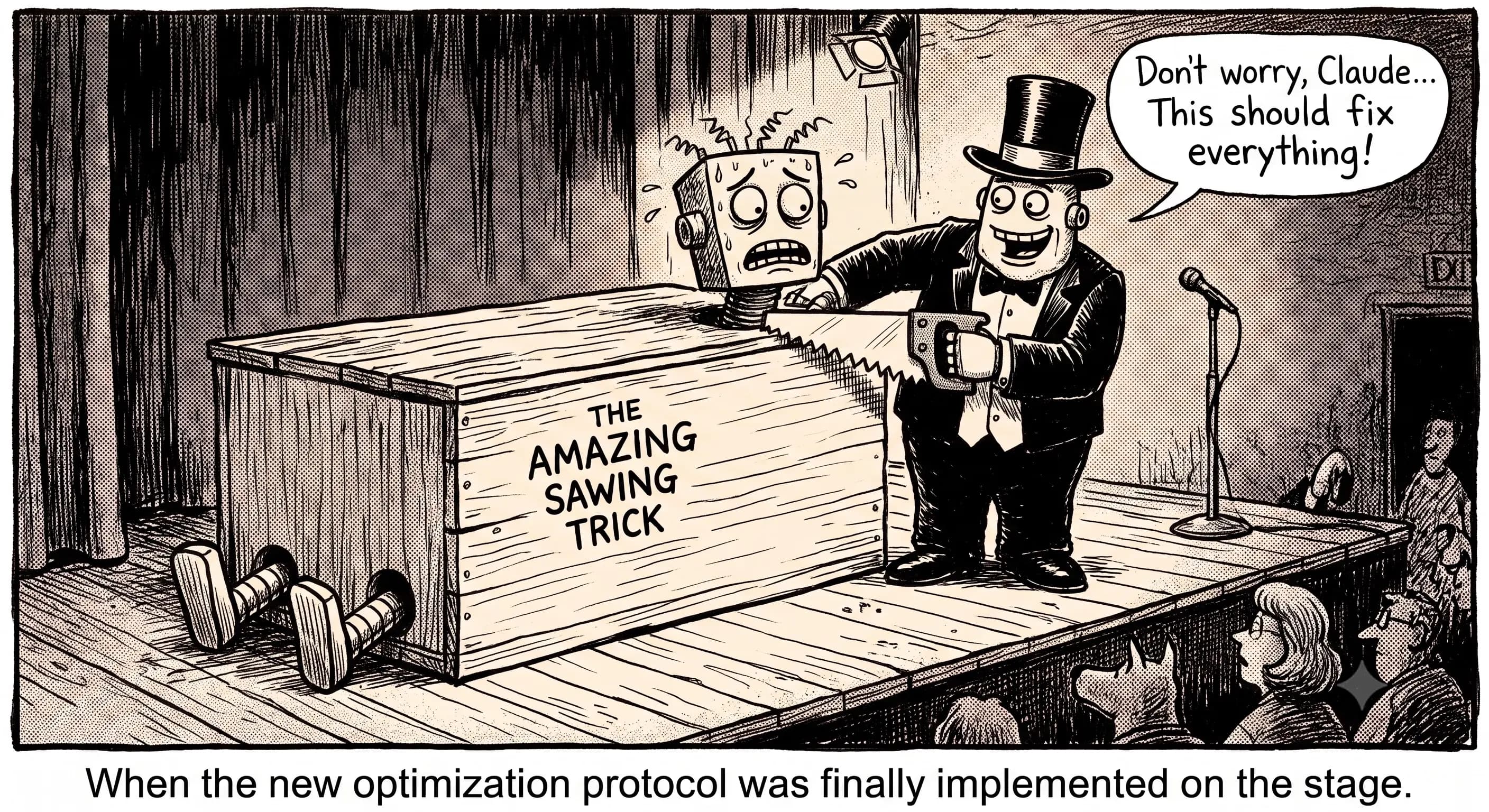
Last Friday, Anthropic said its newest models no longer need the thick book. So they cut more than 80% of the rules out of Claude Code.
Then they ran performance tests, and the scores stayed the same as with the big instruction book.
Two things made that work
The first is judgment.
The old handbook gave a long list of instructions like “never write comments in code.” That rule was wrong some of the time, but it was safer than letting the model guess. The new rule says “match the style of the code around you.”
Shorter, and it fits far more situations.
The second is arguments.
If one file says add documentation where it helps, and another file says never add comments, the model has to stop and work out which one you meant. That costs extra on every single task.
Most people never see this one. You wrote both rules months apart, both sounded reasonable at the time, and neither of them looks like a problem sitting on the page by itself.
But here’s the part that got my attention
You don’t have to say everything up front. The model can go look things up when it needs them.
So you keep one short file, and you put the rest in side files it opens only when the job calls for it. That saves a whole lot on your AI bill.
Which is when I went and looked at my own work.
I built mine this way by accident
I don’t have a crystal ball, and I haven’t bugged Anthropic’s headquarters, but it turns out I built my own instructions this way.
Let me show you what I mean.
My AI Writing Twin workshop runs 90 minutes long. That isn’t much time to cover everything you need.
So when I built the writing skill for it, I could not hand the AI everything I know about voice. There is just too much of it.
I wrote a short version instead, and it came to 427 lines.
Then I put the deep material in separate files. 1,798 lines of pattern analysis and market notes. The AI only opens those when the job calls for them.
I did that to fit a clock. But the token savings were a side benefit.
Anthropic arrived at the same shape from the other direction.
Maestro doesn’t know what the specialists know
That Command Center I counted the lines on? It’s the AI team I run my business with.
Maestro, my AI Chief of Staff, was already designed the way Claude now operates.
Maestro routes the work to the right specialist, but only when it needs work done. Maestro doesn’t know everything the specialist knows.
And doesn’t need to.
It only needs to know the type of work the specialist does and give them the assignment.
The result? Work gets done just-in-time at an expert level, and the AI token cost is a fraction of what it would cost using a big ol’ super AI agent like most people do.
This is the same argument I made in the thesis piece on composing a team instead of inheriting one giant assistant. What’s new is that the company building the models just published the receipts.
Your next moves
- Count your own. Open whatever instruction file your AI reads every session and get the line count. Don’t change anything yet. The number is the point, because the cost stays invisible until something measures it.
- Read it looking for arguments. Two rules that pull in different directions cost you on every task, whether or not the task has anything to do with either rule. This is the cheapest fix on the list and almost nobody does it.
- Ask when each rule is actually needed. Anything used once a month belongs in a side file the AI opens on request. Anything used every session stays put.
- Leave the safety rules alone. Every “never delete this” and “never send without my approval” stays in the main file, whatever it costs. A safety rule that isn’t loaded at the moment it matters is not a safety rule, and this is where I’d expect most people to cut too deep.
One caution before you start deleting. Anthropic ran their own evaluations, on their own product, and the scores held. Nobody has run that test on your agent. What you can count on is the cheaper bill and the easier upkeep, so trim for those and treat anything else as a bonus.
The goal was never less instruction. It was less duplicated instruction, and the right instructions at the right time.
Inside the AI Inner Circle, you build the same thing for your own business: a coordinator who knows who to call, and specialists who carry the depth. See how the membership works →
Did Anthropic really delete 80% of Claude Code’s instructions?
Yes. Anthropic removed over 80% of the Claude Code system prompt for its Claude 5 generation models and reported no measurable loss on its coding evaluations. The claim is specific: same product, same tests, same scores with a far shorter instruction set.
Does a shorter instruction file make my AI agent better?
If you build it the way we do in AI Inner Circle, it does. Maestro, your new AI Chief of Staff, acts as a coordinator that only needs to know what kind of work each specialist handles and when to hand it over. A team of specialist AI agents carries the depth instead, and each one opens its full playbook only for the job in front of it. The coordinator file gets shorter because the expertise moved somewhere better, which means the specialist working on your task has more instruction aimed at that task than one big assistant trying to hold everything at once.
What should I actually cut from my AI instructions?
Anything the AI could work out by looking at the files in front of it, anything only needed once a month, and any two rules that contradict each other. Conflicting rules are the cheapest fix and the one almost nobody checks, because each rule looks reasonable sitting on the page by itself.
What should never be cut?
Safety rules. Every “never delete this” and “never send without my approval” stays in the file that loads every session, whatever it costs. A prohibition that is not loaded at the moment it matters is not a prohibition, and this is where trimming most often goes wrong.
Why does a coordinator plus specialists cost less than one big AI agent?
Because the coordinator only needs to know what kind of work each specialist does, not what the specialist knows. The deep material stays in separate files that open only when a job calls for them, so you pay for expertise at the moment you use it instead of loading all of it into every session.
The Future of AI Agents in Business
One big AI assistant always breaks down. The fix is not a better prompt. It is composition over inheritance: a coordinator running a team of small specialists, the same shift the whole AI industry is converging on.
Why AI Writing Sucks And What To Do About It
AI writing doesn’t fail because it’s artificial. It fails because it lets you settle. A single AI tool playing every role produces average output. Here’s what it looks like when you stop prompting and start commanding a team.
Why Good AI Writing Feels So Wrong
You read the AI draft, every sentence is clean, and it still sounds like a robot. The tell is symmetry, not word choice. Balanced two-part reversals, three-beat lists, matched section endings. Here is how to see it and how to break it.
Why ChatGPT Writing Will Always Sound Robotic
ChatGPT isn’t optimized to sound human. It’s optimized to sound finished. That distinction explains why every fix you’ve tried has worn off within two paragraphs, and why this is a structural problem, not a prompting problem.
How AI-Generated Content Is Destroying Trust
AI writing has a redundancy problem. Three measurable patterns — antithesis density, copula saturation, fragment clustering — are eroding your credibility below the threshold of conscious detection. The fix isn’t better prompting. It’s a quality gate that counts.
The AI Priority Map: What to Automate First in Your Business
Eleven AI tools bookmarked and a business that runs exactly like last year? That is a sequencing problem. The Priority Map scores 12 breaking points across four engines and tells you which bottleneck to fix first, and which AI Assistant fixes it.
How to Get Consulting Clients Without Cold Email (or Ads, or Praying for Referrals)
Cold email burns the domain you invoice from and converts at low single digits. Here’s the signal-based system founder-led firms use to fill the calendar instead, and exactly where an AI assistant helps and where it must not.
The Vacation Test: Can Your Business Run Without You?
If you disappeared for two weeks, what breaks first? The Vacation Test scores how dependent your business is on you, and shows which AI Assistants take over the routine so you stop being the ceiling.
What Is an AI Agent? A Plain-English Definition for Founders
An AI agent completes a whole job, not just answers a question. The plain-English version for a founder-led service business: what an agent is, what it is not, and whether you need one or just ChatGPT.
AI Agent vs. Chatbot vs. Automation vs. ChatGPT: Which One Do You Need?
ChatGPT, chatbot, automation, AI agent: four tools called "AI" that do different jobs. A plain comparison for founders, with what each costs, when it is enough, and when it breaks.
How Much Does an AI Agent Cost? Real Numbers for a Service Business
Quotes for an AI agent run from $21 a month to $300K, and both are real. The honest 2026 numbers for a founder-led service firm: three tiers priced, a fourth hybrid the guides skip, and when an agent is simply a waste of money.
AI Assistant vs. Virtual Assistant: Which Should a Founder Hire First?
The VA agencies say hire a human; the AI vendors say buy an agent. Both are talking their book. The honest split for founder-led firms, and why the sequence is almost always AI first, human second.
Why Your Leads Go Cold (and How AI Follow-Up Fixes Speed-to-Lead)
Your leads aren’t going cold because your service is wrong. They’re going cold because you are the follow-up queue, and you’re billable all day. The founder-led fix for speed-to-lead, without the discipline lecture.
Can AI Answer My Client Emails? What’s Safe, What Isn’t
Yes, AI can answer your email. Whether it should depends on which email. The trust ladder founder-led firms actually use: sort everything, draft-first the client mail, auto-send only the routine, and never let it touch bad news.
Why Slow Quotes Lose Deals (and How to Send Proposals in Hours, Not Weeks)
Your proposal didn’t lose on price or quality. It lost on Tuesday, when a competitor’s arrived first. Why founder-led firms quote slowly, the scope-creep tax inside it, and the same-day proposal system.
5 Things You Should NOT Automate With AI (Yet)
From someone who builds AI systems for a living: five places automation burns money or trust in a founder-led firm, the cheaper fix for each, and the test that tells you when “yet” finally arrives.
Work with me
Find your hidden bottleneck.
A 60-minute Quick Win Consult to pinpoint what is blocking growth and remove it fast.
Book a Quick Win Consult →