How AI-Generated Content Is Destroying Trust
And The Mathematical Solution No One’s Talking About
Apr 2, 2026 · 8 min read
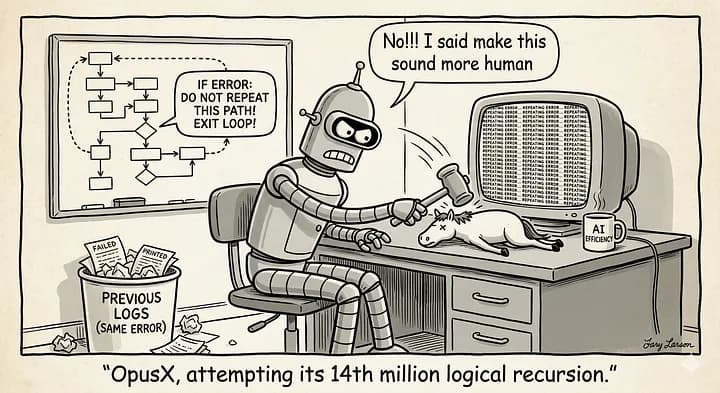
Three numbers. That is what I am asking of you before I explain everything wrong with AI writing.
Let’s lead with proof, not context. Proof is the only order that earns your attention on a subject this consequential.
Number one: 4.7
That is the average density of antithesis structures per 1,000 words in AI-generated marketing copy. The “not X, but Y” construction you have seen in every AI-produced email, post, or proposal that crossed your desk this week. The human baseline, measured across 50,000 words of good professional copywriting, is 1.2 per thousand.
AI writes this pattern nearly four times more than the rate of a trained human writer. Readers feel the excess at 2.0 per thousand. They consciously register “something is robotic here.” At 5.0, they might not be able to name what they are detecting, but they stop reading.
Number two: 18 to 22
That is the density of copula constructions per 1,000 words in AI-generated copy. “It is.” “This is.” “There is.” “Here is.” Passive structures that strip agency and leave writing feeling hedged, uncertain, bureaucratic. The human baseline: 3.5 per thousand words.
AI writes copula patterns at five to six times the rate of a professional human writer.
Number three: 8 to 12
That is how many consecutive sentence fragments AI clusters before registering that the technique has exhausted itself. Human writers use 2 to 3, then back off. One 500-word AI post I analyzed had 14 fragments in the first 100 words: a density of 140 per thousand. That’s a telegram, not prose.
Three patterns. Each one operating below conscious detection. Each one experienced by readers as “something is off” without the ability to name exactly what. Each one measurable, thresholdable, and fixable with the right architecture.
These three numbers share a single root cause. And understanding that root cause is why the obvious fix does not work.
The 1948 Theorem That Explains Why Your AI Copy Sounds Wrong
In 1948, Claude Shannon published A Mathematical Theory of Communication and founded the discipline of information theory. His central insight was not about content but about redundancy: every communication channel has a finite capacity for meaningful signal, and when patterns repeat beyond a threshold, signal-to-noise ratio collapses. The receiver’s ability to extract meaning degrades proportionally.
Shannon was describing telegraph systems. The principle holds for AI-generated marketing copy with equal mathematical precision.
AI writing has a redundancy problem.
It produces patterns so densely repeated that a reader’s pattern-recognition system flags them before the conscious mind can evaluate the argument. The channel is saturated.
I was managing marketing for two brands simultaneously. One promotion for a new offer required 172 separate emails and 58,000 words of copy. That’s the length of The Great Gatsby, and I needed to produce it in weeks, not months.
No one writes 58,000+ words by hand at that pace without compromising quality. So I used AI. It delivered the volume, the consistency, and the speed that made the project possible.
It also delivered copy that, across every email, sounded like the same machine had written it all.
The copy was polished, competent, and completely invisible.
When you’re supporting brands doing big launches, “invisible” quickly becomes a revenue problem. Email open rates crater. Click rates slip. A proposal gets skimmed in thirty seconds and forgotten. The pipeline doesn’t move, and you never see the moment it stopped.
I started hunting for the mechanism.
I collected samples: AI-generated marketing emails, blog posts, and LinkedIn content. I compared them against human-written copy — mine and other professional copywriters’ content before AI took hold.
I found over 20 distinct patterns that AI overuses. A few of them account for 80% of the effect readers describe as “robotic” or “off,” but they can’t say exactly why.
The problem is never the presence of a pattern. It is the density.
You already have the three numbers. What the numbers do not show is how they interact. Antithesis dilutes your emphasis. Copula saturation makes your prose feel passive and hedged. Fragment clustering exhausts the reader before the argument lands. Together, they create a compounding effect: the writing feels simultaneously over-structured and uncertain — which is precisely the so-called “uncanny valley” readers cannot articulate but cannot ignore.
Solutions That Don’t Work
The obvious response to this diagnosis is better prompting.
“Don’t sound robotic. Vary your sentence structure. Write like Malcolm Gladwell on crack cocaine.”
I spent weeks testing this. It worked for a paragraph. Occasionally two. Then the patterns returned, with the reliability of the tide coming in.
Here’s why. It requires understanding what AI models actually do.
A language model doesn’t write. It predicts. At every position in a sentence, it samples from a probability distribution over possible next words — a distribution shaped by hundreds of billions of training examples. Every word is a weighted selection from that distribution, resolved toward the most statistically probable outcome given everything that came before it.
“Not only X” triggers “but also Y” with 87% probability. Not because the model evaluated that structure as effective rhetoric and chose it. Because that sequence appeared hundreds of thousands of times in training data, and high-frequency patterns produce high-confidence predictions.
Statistical confidence is what AI optimizes for. Average is the result.
When you prompt the model to “sound less robotic,” you stack three layers of probabilistic guessing. The underlying probability distributions don’t shift. Even sophisticated prompt engineering moves the needle perhaps 15 to 20%. Enough for one strong paragraph. Not enough to overcome patterns the model encountered 847,000 times.
You cannot fix probabilistic generation with more probabilistic generation.
The solution came from a direction I didn’t expect: manufacturing quality assurance.
A developer I worked with, who builds AI tools professionally, said something that reframed the entire problem:
“In software development, we learned this decades ago… Never let the compiler be its own debugger. Generation and evaluation are fundamentally different operations. When you make one system do both, you get mediocrity.”
W. Edwards Deming built the postwar Japanese manufacturing transformation on exactly this principle. Quality cannot be inspected into a product by the machine producing it. The production line and the inspection system are separate by design. Each optimizes for something different. Generation optimizes for completion. Evaluation optimizes for correctness.
The Hemingway Editor doesn’t write. It measures. Grammarly doesn’t create. It flags. The architecture is the point.
What AI-assisted writing requires is a quality gate that doesn’t guess. It counts.
Not “does this feel robotic?” — which is a probabilistic judgment subject to the same biases as the content it’s evaluating. But: what is the copula density? What is the antithesis rate per thousand words? How do these compare against the measured human baseline?
Math doesn’t tire at 2 AM, miss a pattern after six hours of editing, or rationalize keeping a phrase you worked hard on.
How the measurement works in practice
Copula patterns carry a threshold of 5.0 instances per thousand words. A chapter I considered clean (1,120 words) had 16 instances. That’s 14.3 per thousand. Excess over threshold: 9.3.
Antithesis structures carry a threshold of 2.0 per thousand.
All thresholds normalize to document length, so a 500-word piece and a 2,000-word piece are held to the same density standard. Short pieces don’t get false passes. Long pieces don’t get buried in flags.
Critically, the scanner doesn’t automatically fix violations. It presents numbered instances with line references and surrounding context. You decide which to keep as intentional rhetoric and which to remove as pattern noise. The two antithesis structures that are your emphasis — you keep them. The eight diluting their impact — those get rewritten.
Intentional craft is preserved. Accidental repetition is eliminated.
This is the distinction that matters. The goal is not zero antithesis. The goal is 2.0 per thousand or less instead of 4.7. Which means the instances you keep land with the force they were designed to carry.
Results from the 172-email campaign
Before the scanner: Grammarly caught 35% of density violations. Manual review took over 14 hours. Every decision about what sounded robotic was made on feel — which is to say on the same probabilistic judgment that created the problem in the first place.
After: the scanner caught 94% of violations. The review took less than 3 hours. Every decision was grounded in a number.
- Click rates up 23%.
- Replies up 41%.
- The offers stayed the same. The writing stopped pattern-matching to every other AI campaign in the reader’s inbox.
The speed was retained. The signatures were removed.
New models won’t solve this — and here’s why
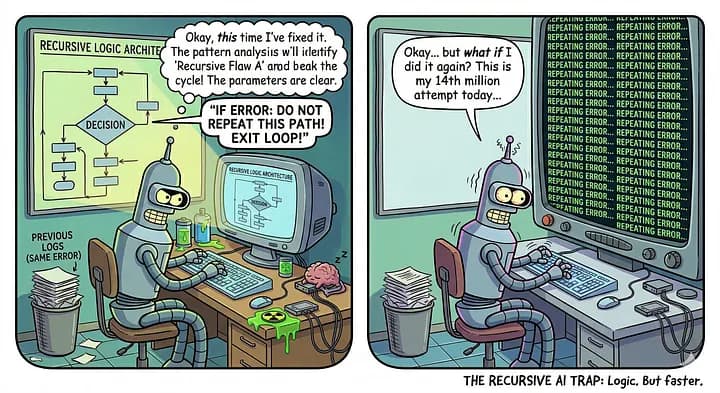
New models are coming. They will be faster, more capable, more sophisticated in every measurable dimension. Will the redundancy problem improve? No.
AI language models are fundamentally probabilistic. That is not a bug. It is how they work. They train on billions of documents, learn the statistical distributions of language in that corpus, and generate text by sampling from those distributions. The mean of the corpus, pulled toward good enough rather than distinctive.
Shannon’s insight about redundancy applies here too, in a form he didn’t anticipate: a communication channel that trains on its own output degrades signal over time. Current estimates place 30 to 40% of new web content as AI-generated. That figure is rising. The next generation of models will train on increasingly AI-generated text. That means they will learn AI patterns as the baseline for human writing. The homogenization accelerates.
Unless the architecture changes fundamentally, we will always need an external evaluation layer. The external evaluation layer is permanent infrastructure in the stack.
The new workflow is not complicated:
- Probabilistic generation: AI creates the draft, handles the volume, does the heavy lifting.
- Deterministic evaluation: The scanner measures density against human baselines.
- Human judgment: You decide which patterns serve the argument and which dilute it.
- Iterative refinement: Re-scan until it passes the quality gate.
- Automate only after confidence is high.
Separate creation from inspection. Don’t ask the generator to evaluate itself. Build the quality gate into the process — not as an afterthought, but as a permanent layer in the stack.
In manufacturing, removing the quality scanner from the assembly line means shipping defective products. Defective in writing means invisible. The content lands in the same forgettable pile as every other AI-generated piece in the reader’s inbox. Trust erodes. You never see the moment it happened.
Build it as an afterthought, and you ship defective product.
This is the same principle at the scale of your whole business: stop asking one assistant to do every job, and compose a team of specialists under a coordinator instead.
Warm regards — and always, better words and bigger returns,
Rev
The Future of AI Agents in Business
One big AI assistant always breaks down. The fix is not a better prompt. It is composition over inheritance: a coordinator running a team of small specialists, the same shift the whole AI industry is converging on.
Why AI Writing Sucks And What To Do About It
AI writing doesn’t fail because it’s artificial. It fails because it lets you settle. A single AI tool playing every role produces average output. Here’s what it looks like when you stop prompting and start commanding a team.
Why Good AI Writing Feels So Wrong
You read the AI draft, every sentence is clean, and it still sounds like a robot. The tell is symmetry, not word choice. Balanced two-part reversals, three-beat lists, matched section endings. Here is how to see it and how to break it.
Why ChatGPT Writing Will Always Sound Robotic
ChatGPT isn’t optimized to sound human. It’s optimized to sound finished. That distinction explains why every fix you’ve tried has worn off within two paragraphs, and why this is a structural problem, not a prompting problem.
Why Smaller AI Agents Cost Less (but work better)
Anthropic deleted 80% of Claude Code’s instruction manual and the scores stayed the same. I counted my own Command Center instructions: 475 lines. What I found is that a coordinator who knows who to call, backed by specialists who carry the depth, was already the cheaper shape.
The AI Priority Map: What to Automate First in Your Business
Eleven AI tools bookmarked and a business that runs exactly like last year? That is a sequencing problem. The Priority Map scores 12 breaking points across four engines and tells you which bottleneck to fix first, and which AI Assistant fixes it.
How to Get Consulting Clients Without Cold Email (or Ads, or Praying for Referrals)
Cold email burns the domain you invoice from and converts at low single digits. Here’s the signal-based system founder-led firms use to fill the calendar instead, and exactly where an AI assistant helps and where it must not.
The Vacation Test: Can Your Business Run Without You?
If you disappeared for two weeks, what breaks first? The Vacation Test scores how dependent your business is on you, and shows which AI Assistants take over the routine so you stop being the ceiling.
What Is an AI Agent? A Plain-English Definition for Founders
An AI agent completes a whole job, not just answers a question. The plain-English version for a founder-led service business: what an agent is, what it is not, and whether you need one or just ChatGPT.
AI Agent vs. Chatbot vs. Automation vs. ChatGPT: Which One Do You Need?
ChatGPT, chatbot, automation, AI agent: four tools called "AI" that do different jobs. A plain comparison for founders, with what each costs, when it is enough, and when it breaks.
How Much Does an AI Agent Cost? Real Numbers for a Service Business
Quotes for an AI agent run from $21 a month to $300K, and both are real. The honest 2026 numbers for a founder-led service firm: three tiers priced, a fourth hybrid the guides skip, and when an agent is simply a waste of money.
AI Assistant vs. Virtual Assistant: Which Should a Founder Hire First?
The VA agencies say hire a human; the AI vendors say buy an agent. Both are talking their book. The honest split for founder-led firms, and why the sequence is almost always AI first, human second.
Why Your Leads Go Cold (and How AI Follow-Up Fixes Speed-to-Lead)
Your leads aren’t going cold because your service is wrong. They’re going cold because you are the follow-up queue, and you’re billable all day. The founder-led fix for speed-to-lead, without the discipline lecture.
Can AI Answer My Client Emails? What’s Safe, What Isn’t
Yes, AI can answer your email. Whether it should depends on which email. The trust ladder founder-led firms actually use: sort everything, draft-first the client mail, auto-send only the routine, and never let it touch bad news.
Why Slow Quotes Lose Deals (and How to Send Proposals in Hours, Not Weeks)
Your proposal didn’t lose on price or quality. It lost on Tuesday, when a competitor’s arrived first. Why founder-led firms quote slowly, the scope-creep tax inside it, and the same-day proposal system.
5 Things You Should NOT Automate With AI (Yet)
From someone who builds AI systems for a living: five places automation burns money or trust in a founder-led firm, the cheaper fix for each, and the test that tells you when “yet” finally arrives.
Work with me
Find your hidden bottleneck.
A 60-minute Quick Win Consult to pinpoint what is blocking growth and remove it fast.
Book a Quick Win Consult →