The Future of AI Agents in Business
Dec 19, 2025 · 9 min read
We’ve all done it. You sign up for the AI tool everyone’s talking about. You add the Chrome extension, then save a folder of prompts that promised to change your business. Somewhere around 11 pm you wire up an automation, feeling like a genius.
But does it get real work done? If you’re like most service business owners, the sad answer is, “Not really.”
You’ve got a folder full of tools and a business that still depends on you. Either that or accept generic AI output. The AI didn’t take work off your plate. It gave you more open tabs.
Here’s what I found after building with these tools for years: the problem is the shape of the thing you’re building. Tools and prompts are downstream of that.
Let me show you what I mean.
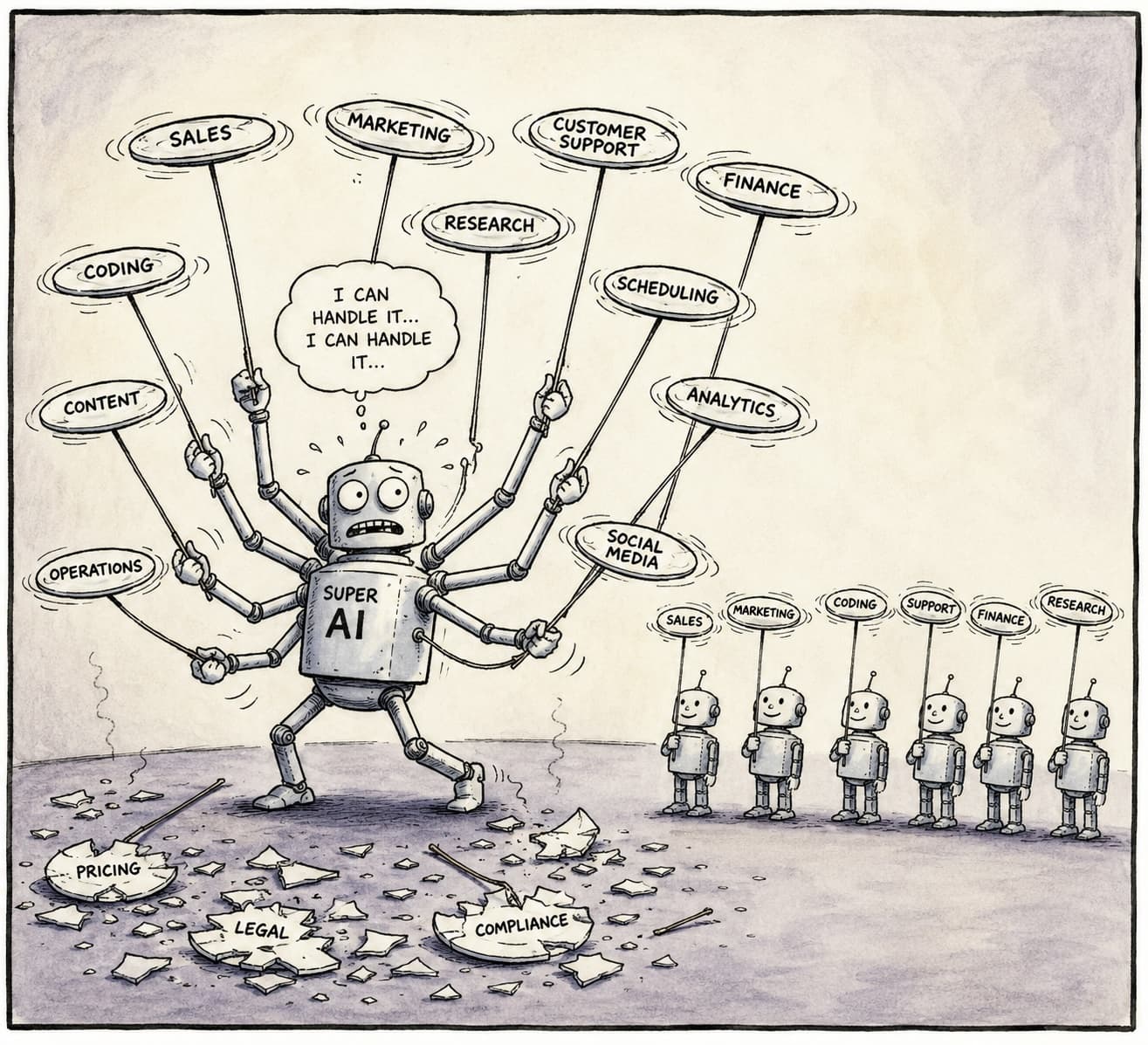
Why one super AI assistant always breaks down
Most people build the same thing. One big assistant. Then they pile stuff onto it. A skill for writing emails. A plugin for your calendar. A connector for your CRM. Another skill. Another plugin. The theory is simple: the more you bolt on, the more it can do.
Engineers have a name for this. It’s called inheritance: you take one thing and keep adding attributes to it, hoping it grows into everything you need.
Here’s the deal. It works… at least for a while.
Five skills, and your assistant hums. But when you add a few more skills, something changes. It’s worse than when you started. The thing gets slower, dumber, more confused. It forgets what you asked.
There’s research on this now that shows it’s a real effect, but you don’t need a study. You’ve felt it. The more you crammed in, the less it actually did.
What I learned building my “forever” house
When I built my “forever” house on 40 acres overlooking the lake, I didn’t do it myself.
I designed it. I drew up the blueprints. I knew exactly what I wanted every room to feel like. Then I did the smartest thing in the entire project: I hired a general contractor named Jeff.
Jeff rarely picked up a hammer. That wasn’t his job. His job was to scope the work, set the schedule, and bring in the specialists: the electrician, the plumber, the framer, the roofer. Each one was great at one trade and did nothing else. When the electrician finished, the GC checked the work before I ever looked at a wall. I approved what was done, and I stayed out of the operating.
Think about it. Nobody builds a house by handing one person a bigger and bigger toolbox. You’d never do that. You bring in a team of specialists and one person to run them.
So why are we building our AI capabilities in exactly the same way we’d never build anything important?
There’s an old rule in software that fits perfectly here: composition over inheritance.
Compose many small specialists, each excellent at one job, and put a coordinator over the top. That’s how competent work has always gotten done, long before any of this was software.
Here’s the map, and it’s almost too clean:
- You are the architect. You own the blueprints, because you designed the business.
- The coordinator is your general contractor. It scopes, schedules, and checks the work.
- The specialists are your subcontractors. One job each, done well.
- The on-call pool is the GC’s Rolodex, the extra hands you bring in when a job needs someone you don’t keep on staff.
A tool does a task. A team runs a whole function, and that gap is the shift this entire piece is about.
The whole AI industry is heading this way
Now, I’ll be the first to admit I didn’t see all of this coming. I didn’t sketch it on a napkin and predict the future. I built it because the one-assistant version kept failing me, and this was the only thing that worked.
But here’s what makes me confident it’s not a fluke. While I was building, some of the biggest names in software were arriving at the same place.
Vercel, the company a huge chunk of the web runs on, shipped a framework for building agents and called it “Next.js for agents.”
The big idea? An agent is just a folder of files.
Microsoft did something similar inside the world’s most popular code editor: agent skills, stored as plain markdown files, in a folder.
Anthropic built the same folder-native approach into the tool my system runs on. And a growing group of engineers has a name for the specialists: domain-specific agents. Each one small, focused on a single job.
Four serious, independent directions. All of them landed on the same setup: a folder holding a team of specialists, with a coordinator to run them.
When the people building the roads and the people building the cars agree on the same design, that’s the way forward.
I just got there early, and I got there by solving a real problem of my own.
The architecture, in plain English
So what does this actually look like? It’s simpler than you’d think.
Everything lives in one folder on your computer. A folder you own. Inside it:
- A coordinator: the general contractor. It reads everything, routes the work, and checks it.
- A business brain: your company’s DNA. Your voice, your offer, who you serve. Every specialist reads this before it does a thing, so nothing sounds generic.
- A memory: the stuff that used to live only in your head. Client quirks. Past decisions. What worked and what cost you money.
- A board: the work in motion. What’s planned, what’s in progress, what needs your sign-off.
- A team: the specialists themselves, each in its own little folder, hired one at a time.
No code and no wiring, which also means no monthly stack of subscriptions. It runs on a plan that costs as little as $20 a month.
And here’s the part that makes this work. The files are the memory. Close the tab, come back tomorrow, and the AI doesn’t have amnesia. The business you built is still sitting there in the folder, exactly where you left it. It remembers.
That’s the difference between a chat and a system.
Why owning the folder beats renting the app
Let me put the two side by side, because this is the part most people miss.
From: AI is a tool I rent. It lives on someone else’s servers. When I stop paying, it’s gone, and my business knowledge is scattered across a dozen vendors I don’t control.
To: AI is a team I own. It lives in a folder on my machine. The knowledge compounds every time I use it. And it’s mine.
Read that again. When you rent apps, your business gets spread thin across a handful of databases. When you own the folder, a few things happen that never happen with rented tools.
- It’s portable. The whole team fits in a folder you can copy, back up, or hand to someone else.
- It gets smarter every month. The memory grows, and the specialists build on each other’s work.
- Adding a capability means hiring. When you need something new, you hire another specialist and drop it in, the way you’d call a subcontractor off the Rolodex. No shopping around for another subscription.
Over time you end up holding one asset you own outright.
What it looks like when it’s running
Here’s where it gets good, because the specialists don’t work in isolation. They hand off to each other, the way a real team does.
It starts with the offer: getting crystal clear on what you sell and why it’s worth it. That work feeds the next hire, who fills the calendar. The calendar feeds whoever builds your content engine, and the content engine feeds a deal desk that turns conversations into proposals. From there it reaches the specialist who moves the daily grind out of your head and onto paper, and finally the one who protects the clients you already fought to win.
Each specialist’s output becomes the next one’s raw material. The offer sharpens the outreach, which fills the pipeline that feeds the deals. Nothing gets rebuilt from scratch, because the folder remembers all of it.
And your job through all of this? You approve. The general contractor brings you finished work, and you say yes, no, or fix this. You’re back to being the architect, out from under the drywall.
That’s the whole promise: a team that runs a function while you run the business.
What this is not
This is not autonomous magic. It doesn’t run your business while you sleep. The whole design keeps you in the loop on purpose: you approve the work before it goes out the door, because your name is on it and a machine shouldn’t have the last word on that. That’s the feature. It’s the difference between a team you trust and a bot you’re scared to leave alone.
It’s not zero effort, either. You still have to know your business well enough to make the calls, and then give real feedback when the work comes back. A great GC can’t build the house if the owner won’t decide where the kitchen goes.
And it’s not for everyone. If you want a magic button, this isn’t it. If you want to build something you own that gets better every month, now we’re talking.
The shift
Here’s the bottom line.
The winners in this next stretch will be the people who started building a team they own, while everyone else is still collecting AI tools like they are Infinity Stones.
The exhausted assistant with forty skills bolted onto it has to go, along with the scattered pieces you’re renting from a dozen vendors. Go be the architect. Hire your general contractor, then let the specialists do what they’re great at while you keep your hand on the one thing that was always yours: the final yes.
Your next moves:
- Audit your stack: List every AI tool you’re paying for right now. Circle the ones that actually take work off your plate, rather than just adding yet another open tab. Be honest.
- Name your functions, not your tasks: Write down the five functions your business runs on: offer, marketing, sales, operations, client care. That list is your org chart, and it’s who you’re about to hire.
- Pick your first specialist: Choose the one function that’s leaking the most money or time right now. That’s your first hire. Just the one that hurts most today.
- Draw the line between architect and technician: For one week, notice every time you’re doing work a specialist should own. That list is your blueprint.
You got this. You’d never build a house the way people are using AI. There is a better way to use AI in your business.
Why AI Writing Sucks And What To Do About It
AI writing doesn’t fail because it’s artificial. It fails because it lets you settle. A single AI tool playing every role produces average output. Here’s what it looks like when you stop prompting and start commanding a team.
Why Good AI Writing Feels So Wrong
You read the AI draft, every sentence is clean, and it still sounds like a robot. The tell is symmetry, not word choice. Balanced two-part reversals, three-beat lists, matched section endings. Here is how to see it and how to break it.
Why ChatGPT Writing Will Always Sound Robotic
ChatGPT isn’t optimized to sound human. It’s optimized to sound finished. That distinction explains why every fix you’ve tried has worn off within two paragraphs, and why this is a structural problem, not a prompting problem.
How AI-Generated Content Is Destroying Trust
AI writing has a redundancy problem. Three measurable patterns — antithesis density, copula saturation, fragment clustering — are eroding your credibility below the threshold of conscious detection. The fix isn’t better prompting. It’s a quality gate that counts.
Why Smaller AI Agents Cost Less (but work better)
Anthropic deleted 80% of Claude Code’s instruction manual and the scores stayed the same. I counted my own Command Center instructions: 475 lines. What I found is that a coordinator who knows who to call, backed by specialists who carry the depth, was already the cheaper shape.
The AI Priority Map: What to Automate First in Your Business
Eleven AI tools bookmarked and a business that runs exactly like last year? That is a sequencing problem. The Priority Map scores 12 breaking points across four engines and tells you which bottleneck to fix first, and which AI Assistant fixes it.
How to Get Consulting Clients Without Cold Email (or Ads, or Praying for Referrals)
Cold email burns the domain you invoice from and converts at low single digits. Here’s the signal-based system founder-led firms use to fill the calendar instead, and exactly where an AI assistant helps and where it must not.
The Vacation Test: Can Your Business Run Without You?
If you disappeared for two weeks, what breaks first? The Vacation Test scores how dependent your business is on you, and shows which AI Assistants take over the routine so you stop being the ceiling.
What Is an AI Agent? A Plain-English Definition for Founders
An AI agent completes a whole job, not just answers a question. The plain-English version for a founder-led service business: what an agent is, what it is not, and whether you need one or just ChatGPT.
AI Agent vs. Chatbot vs. Automation vs. ChatGPT: Which One Do You Need?
ChatGPT, chatbot, automation, AI agent: four tools called "AI" that do different jobs. A plain comparison for founders, with what each costs, when it is enough, and when it breaks.
How Much Does an AI Agent Cost? Real Numbers for a Service Business
Quotes for an AI agent run from $21 a month to $300K, and both are real. The honest 2026 numbers for a founder-led service firm: three tiers priced, a fourth hybrid the guides skip, and when an agent is simply a waste of money.
AI Assistant vs. Virtual Assistant: Which Should a Founder Hire First?
The VA agencies say hire a human; the AI vendors say buy an agent. Both are talking their book. The honest split for founder-led firms, and why the sequence is almost always AI first, human second.
Why Your Leads Go Cold (and How AI Follow-Up Fixes Speed-to-Lead)
Your leads aren’t going cold because your service is wrong. They’re going cold because you are the follow-up queue, and you’re billable all day. The founder-led fix for speed-to-lead, without the discipline lecture.
Can AI Answer My Client Emails? What’s Safe, What Isn’t
Yes, AI can answer your email. Whether it should depends on which email. The trust ladder founder-led firms actually use: sort everything, draft-first the client mail, auto-send only the routine, and never let it touch bad news.
Why Slow Quotes Lose Deals (and How to Send Proposals in Hours, Not Weeks)
Your proposal didn’t lose on price or quality. It lost on Tuesday, when a competitor’s arrived first. Why founder-led firms quote slowly, the scope-creep tax inside it, and the same-day proposal system.
5 Things You Should NOT Automate With AI (Yet)
From someone who builds AI systems for a living: five places automation burns money or trust in a founder-led firm, the cheaper fix for each, and the test that tells you when “yet” finally arrives.
Work with me
Find your hidden bottleneck.
A 60-minute Quick Win Consult to pinpoint what is blocking growth and remove it fast.
Book a Quick Win Consult →