Most AI projects solve the wrong problem.
They start with a tool, a demo, or a list of things a business could automate. Then somebody spends four months and a five-figure budget making the wrong process faster.
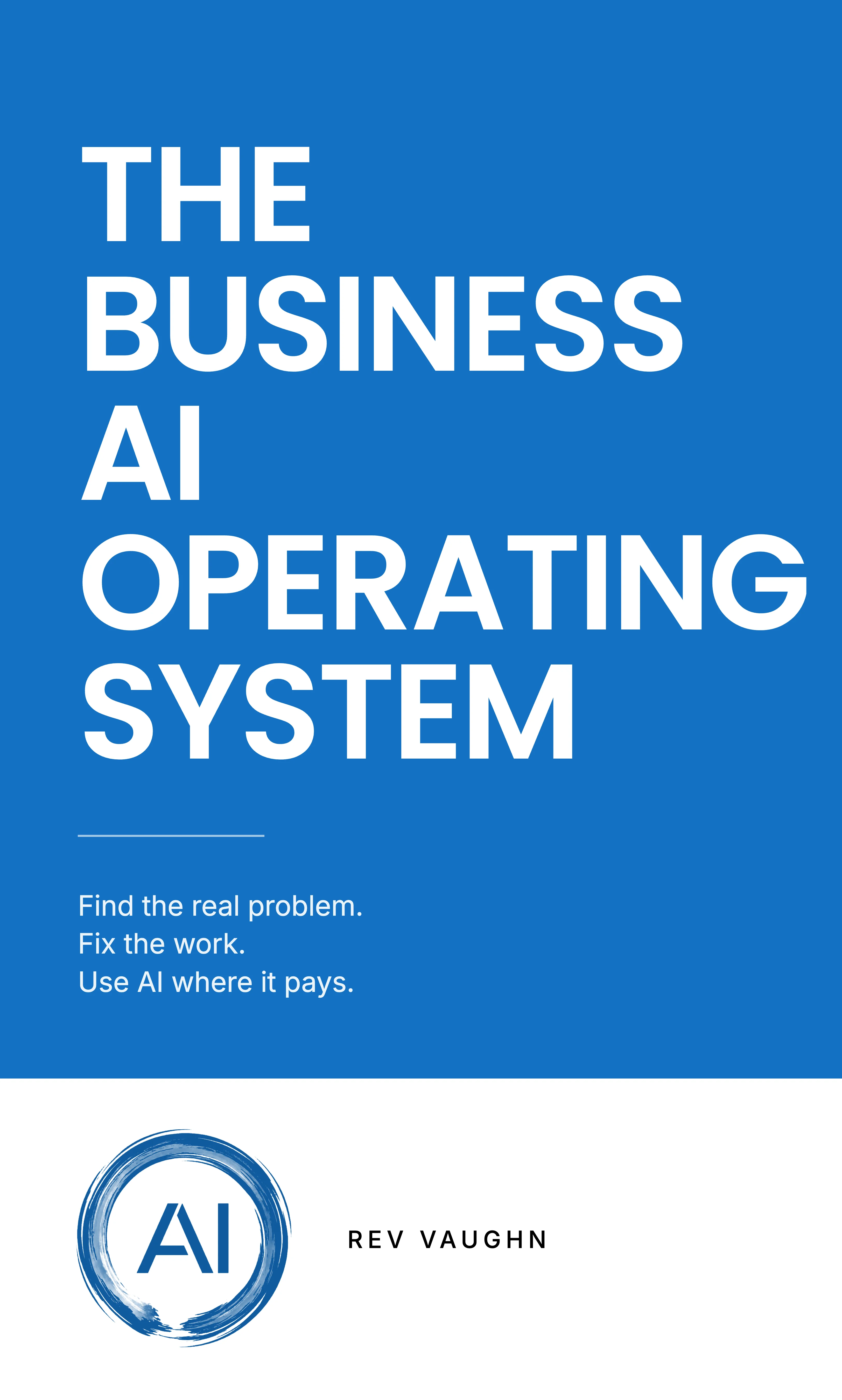
This book teaches the method that finds the right problem first. Five stages, seventeen chapters, and no tool list anywhere in it.
Get the Book →17 chapters. 56 tools and tests. 239 rules of thumb, all indexed.
Written for founder-led businesses, not enterprise AI teams.
Four chapters pass before AI gets a serious mention. That is deliberate.
Capability is not a strategy.
Every week a business owner tells me they know they should be doing more with AI and have no idea where to start. It is an honest sentence and it deserves a real answer.
The problem is not that they picked the wrong tool. The problem is that the question points at the technology instead of at the business, and following it costs money in a way that does not show up until month five.
A list of things AI could do is a menu. Somebody still has to decide what to order.
About 70% of the plan did not need to be built.
A client came to me with an eleven-item AI build list, a vendor, and a number already in his head. He wanted a thumbs-up. I asked to trace the work first.
Four of the eleven items were legacy tasks that had outlived their reason years earlier, and nobody had thought to stop doing them. Three more were already covered by software he was paying about $400 a month for and barely using. One would have run better as a forty-line script.
Building the original list would have taken weeks and a five-figure budget, and at the end he would have owned more technology than the result justified.
That decision was only on the table because we traced the work first. This book is the method behind that conversation.
Five stages, run in order.
The order is the argument. Nothing gets applied before it has been found and fixed. Nothing gets scaled before it has been measured.
- 01
Find. Find what is broken and what it costs
Spot the friction your team hands you every week without labeling it. Put a defensible number on it. Map how the work truly moves. Turn twenty possible improvements into three real priorities.
Chapters 1-4 - 02
Fix. Fix the work before you automate it
Delete what should not exist. Simplify what remains. Sort out who owns the exceptions. Design the workflow you would build today, then choose the least complex solution that reliably does the job.
Chapters 5-7 - 03
Apply. Use AI where it genuinely pays
Find where rules stop working and judgment starts. Decide how much authority a system gets. Keep people where people matter. Give AI data worth trusting and boundaries you chose.
Chapters 8-12 - 04
Measure. Prove the business actually got better
Build the baseline before you touch anything. Measure the whole workflow instead of the impressive step. Turn saved hours into business economics, and know the difference between capacity and cash.
Chapters 13-14 - 05
Improve. Make it stick, scale it, and go again
Close the gap between installing something and implementing it. Expand the pattern that proved out without spreading the one that did not. Then return to Find, on a business that is no longer the one you started with.
Chapters 15-17
Four of the six answers need no new technology.
Chapter 5 gives you a ladder and tells you to stop at the first rung that solves the problem. Most businesses are sold the bottom rung first.
- 01
Delete the work
No new tech - 02
Simplify the process
No new tech - 03
Fix who owns the work
No new tech - 04
Use software you already own
No new tech - 05
Add a basic automation
Automation - 06
Add AI where the work needs judgment
AI
Built to be used, not just read.
17 chapters
Each one ends with a Practical Application that operates on a real problem in your business, not a hypothetical one.
56 tools and tests
The Priority Map, the Friction Map, the Authority Spectrum, the Guardrail Map, the Scorecard, the Business Case, and fifty more. All indexed by chapter.
239 rules of thumb
Every one collected in the appendix and grouped by stage, so the whole method comes back cold when you need it in a meeting.
No tool list
Almost no products are named anywhere in the book. Tool lists expire. The decision method does not.
Pick one real problem in your business before Chapter 1 and carry it the whole way through. Read it that way and you finish with a plan. Read it as theory and you finish with notes.
The four that decide whether AI pays.
Should this work exist at all?
The cheapest task to automate is the one you stop doing. Four chapters arrive before AI does, on purpose.
How much authority should AI have?
Help, Understand, Recommend, Prepare, Execute, Adapt. Six levels of responsibility, and more is not better.
Where do my people still matter?
Judgment, trust, empathy, creativity, relationship, accountability. Protect those. Automate what surrounds them.
Did any of this actually pay?
Without a baseline you cannot prove improvement, and saved hours are not saved money until something claims them.
- +
You are a founder, owner, or founder-led service business
- +
Your judgment is part of what customers are buying
- +
Your own time is the real constraint on growth
- +
You suspect you are behind on AI and are unsure where to start
- +
You have tried a few tools with forgettable results
- −
You want a list of the best AI tools this quarter
- −
You want prompt templates you can paste
- −
You want to be told AI transforms everything
- −
You are looking for code or technical implementation

I build revenue systems. AI is one part of that work.
I have started or helped build more than a dozen businesses across six countries, grew a company past $20 million a year across 26 markets, and built the 172-email lifecycle system behind a $6.57 million live-event launch.
Growth at that scale depends on clear systems, ownership, data, and handoffs. Every method in this book is one I use, and the book will regularly tell you not to build the thing you came in wanting.
Five stages. Seventeen chapters. 163 pages, and no tool list in any of them.
Written for entrepreneurs, business owners, and founder-led service businesses where the founder is still the face and voice of the company.
You get all 17 chapters, the 56 tools and tests indexed by chapter, and every one of the 239 rules of thumb collected by stage in the appendix.
Get the Book →What to know before you read it.
Do I need to be technical to use this book?
No. There is no code, no prompt library, and no tool list. What the book asks for is business thinking you already do, pointed at a problem you have not aimed it at yet.
Will this be out of date when the models change?
The book deliberately names almost no products. It teaches diagnosis, workflow design, prioritization, measurement, and governance, which are the parts that outlive any specific tool.
Is this a book about using ChatGPT?
No. Four chapters pass before AI gets a serious mention. Four of the six rungs on the central decision ladder require no new technology at all.
How is this different from every other AI book?
Most AI books answer what the tools can do. This one starts with the business problem and treats the technology as the last decision rather than the first. It will regularly tell you not to build the thing you came in wanting.
Who is it written for?
Entrepreneurs, business owners, and founder-led service businesses where the founder is still the face and voice of the company and their time is the real constraint on growth.
Do I have to buy the audit to use the book?
No. The book teaches the entire method, including every tool and test used in the paid engagement. The audit exists for owners who would rather have it run on their business than run it themselves.
The book teaches the method. The audit runs it on your business.
Everything in the paid engagement is in the book, including every tool and test. Plenty of owners will read it and run the diagnosis themselves, and that is the point of writing it.
If you would rather have one workflow traced for you and leave with a First-Project Decision, a Blueprint, and a 90-day plan, that is the Business-First AI Audit.
See the Business-First AI Audit →